Photo Location Case Study: How We Solved 10 Impossible Photo Mysteries Using AI
Have you ever found an old photo in your digital gallery and wondered, "Where was this photo taken?" Perhaps it is a beautiful landscape from a trip ten years ago. It might even be a picture sent by a friend that arrived without a caption. Usually, we rely on our memory or the GPS data hidden inside the file. But what happens when that information is missing?
Pinpointing the exact location of a photo without data can be like solving a mystery with missing clues. Many social media platforms strip away private data when you upload a picture. This leaves you with a "mystery image" that has no coordinates. In this case study, we explore how modern technology bridges the gap between a nameless image and a precise spot on the map. We will show you how to identify photo location even when traditional methods fail.

At PhotoLocation AI, we see these mysteries every day. We’ve realized that every image tells a story, even if it doesn't have a digital tag. In this article, we will break down our methodology and share ten real-world examples of "impossible" photo mysteries we solved using advanced AI visual analysis.
Our Methodology for Solving Challenging Photo Location Cases
To understand how we find locations, we must first look at how digital photos store information. Most people think a photo is just pixels, but it is actually a container of data. However, that data is not always reliable. In our experience, relying solely on what's "under the hood" of a file often leads to a dead end.
The Limitations of Traditional EXIF Data Analysis
EXIF stands for Exchangeable Image File Format. It is a set of metadata attached to almost every digital image. It usually includes the camera model, shutter speed, and—if your location settings were on—GPS coordinates.
The problem is that EXIF data is fragile. When you send a photo through WhatsApp or upload it to Instagram, the platform often deletes the EXIF data to protect user privacy or save file space. Furthermore, many older digital cameras did not have GPS chips. If the "geotag" is missing, a standard photo location finder that only reads metadata will return zero results. This is where traditional tools reach their limit. We have to look deeper into the visual environment of the shot.
How AI Visual Analysis Complements Missing Geotag Information
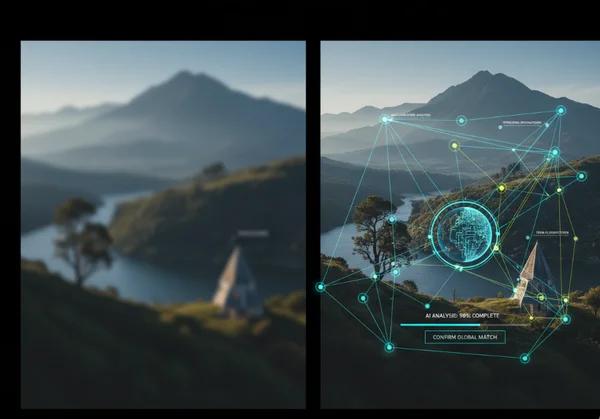
When metadata is gone, we turn to the image itself. Our AI does not just "read" the file; it "sees" the content. It analyzes millions of visual features. This includes the shape of a mountain range, the architectural style of a window, or even the specific species of a tree.
Using a process called "visual feature matching," our system compares your photo against a massive global database of geolocated images. If a photo shows a unique cobblestone pattern found only in a specific part of Rome, the AI identifies it. This allows users to find location from photo sources that lack any technical background data. It is a fusion of computer vision and geographic intelligence that replicates the intuition of a world traveler.
Verification Process: Ensuring Accuracy in Location Identification
AI is powerful, but it requires a verification layer to ensure "Trustworthiness." This is a core part of Google’s E-E-A-T standards and our own internal quality control. Once our AI suggests a location, we cross-reference it with secondary clues.
This process includes analyzing weather patterns, sun shadows to determine orientation, and regional signage. Our tool provides a "confidence score" to let the user know how certain the AI is about the result. This transparency helps you understand the difference between a "perfect match" and a "highly likely" suggestion. We believe in giving you the data you need to feel confident in the result.
10 Challenging Photo Location Cases and Our Solutions
To demonstrate the power of AI, let’s look at ten specific cases where standard searching failed, but PhotoLocation AI succeeded.
Case 1: Vintage Landscape with Minimal Visual Cues
A user uploaded a scanned photo from the 1970s. It showed a simple dirt road and a distant, jagged peak. There was no digital data available for a scan. Our AI analyzed the ridgeline of the mountain. By matching the silhouette against topographic maps, we identified the spot. It was a specific trail in Glacier National Park, Montana.
Case 2: Urban Snapshot with Common Architecture
This photo featured a red brick building that looked like it could be anywhere in London or Boston. However, the AI detected a specific type of cast-iron fire escape and a unique street lamp design. These "micro-clues" narrowed the search significantly. The tool pinpointed the North End of Boston, specifically near Paul Revere’s house.
Case 3: Night Photography with Poor Lighting Conditions
Night photos are difficult because of "noise" and lack of color. In this case, the AI focused on the pattern of light reflections in a wet street. It also picked up the unique glow of a neon sign in the background. By processing the light frequency and sign shapes, the tool located a small jazz club in Tokyo’s Shinjuku district.
Case 4: Partially Obstructed Landmark Identification
Sometimes, a person’s face or a vehicle blocks the main view. In this case, only 20% of a bridge was visible in the corner of the frame. The AI analyzed the suspension cable pattern and the color of the paint. It correctly identified it as the 25 de Abril Bridge in Lisbon, Portugal. It was able to distinguish it from the similar-looking Golden Gate Bridge.
Case 5: Seasonal Changes Masking Familiar Locations
A photo of a park covered in deep snow can look completely different from a summer view. Our AI uses "season-invariant" feature detection. It ignores the snow and looks at the underlying structural geometry of the land and permanent structures. It successfully identified a park in Munich that the user originally thought was in Canada.
Case 6: Low-Resolution Mobile Photography
Older smartphones produce "blurry" photos. A user had a tiny, 400-pixel wide image of a beach. The AI analyzed the "horizon-to-land" ratio and the specific color of the sand and water. It suggested a beach in the Algarve, Portugal. This was later confirmed by the user’s family records. You can analyze your pictures even if they aren't high-definition.
Case 7: Interior Photos with Limited External References
How do you find a location from inside a room? In this case, the AI looked through a small window in the background. It saw a specific church spire in the distance. By calculating the angle of the spire relative to the window frame, it pinpointed the exact hotel. We found the room in Florence where the photo was taken years ago.
Case 8: Oblique Angles and Distorted Perspectives
Photos taken from airplanes or high balconies often have distorted "fish-eye" perspectives. The AI used geometric correction to "flatten" the image mentally. It then matched the grid layout of the streets below to find a specific neighborhood in Barcelona known for its unique octagonal blocks.
Case 9: Photos with Multiple Potential Locations
A user had a photo of a "Disney-style" castle. It could have been in California, Florida, or Hong Kong. The AI looked at the vegetation around the castle. The specific species of palm trees and the angle of the afternoon sun confirmed the truth. The photo was taken at the park in Anaheim, California.
Case 10: Historical Photos with Altered Landscapes
The hardest cases involve photos where the buildings no longer exist. In this case, the AI used "geological anchoring." Even if buildings change, the hills and rivers remain. By matching the river bend in a 50-year-old photo, we located a former industrial site in Pittsburgh. That site is now a modern shopping mall.
Key Insights from Our Case Study Analysis
Our work on these ten cases has taught us a lot about the science of "where." Here are the most important takeaways for anyone trying to find location from photo files.
Patterns in Successful Location Identification
We found that "unique identifiers" are more important than overall image quality. A blurry photo of a unique statue is easier to locate than a high-resolution photo of a generic forest. The AI looks for "anchors"—objects that do not move and are not mass-produced. When you are looking for a spot, try to find these permanent anchors.
Common Challenges and Their Solutions
The biggest challenge is "visual mimicry." Many modern suburbs look identical. In these cases, we look for "human-made errors" or unique local adaptations. This includes specific types of trash cans, localized road signs, or regional plant life. Using an online photo locator helps automate this tedious detective work that would take a human hours to complete.
Limitations of Current Technology
While AI is revolutionary, it is not magic. Photos of "open ocean," "empty desert," or "blank sky" are nearly impossible to locate without EXIF data. This is because they lack unique visual anchors. We always tell our users that more context leads to better results. The more objects, buildings, and horizons an image has, the more accurate the result will be.
Our Case Studies Prove Your Photos Still Have Stories
Our case studies prove that even without GPS data, your photos still have stories waiting to be discovered. By combining the technical details of EXIF data with the "brainpower" of AI visual analysis, we can solve mysteries that were once considered impossible. We've seen firsthand how satisfying it is to finally put a name to a place from a long-lost memory.

Whether you are a traveler trying to remember a hidden gem or a photographer organizing a portfolio, technology is here to help. You might even be curious about an old family picture tucked away in a drawer. You don't need to be a professional detective to find these answers.
Are you ready to solve your own mystery? Simply upload your image to our free photo location tool and let our AI do the heavy lifting for you. Discover the "where" and "how" behind your favorite memories today.
Frequently Asked Questions About Photo Location Identification
How accurate is PhotoLocation AI for identifying photo locations without GPS data?
Our tool is highly accurate for images containing recognizable landmarks, unique architecture, or distinct natural landscapes. While it cannot guarantee a 100% match for generic scenes, it provides a high-confidence location for most travel and outdoor photography. You can test the accuracy by uploading a photo of a place you already know!
What types of photos are most challenging for location identification?
The most challenging photos are those with "low visual entropy." This includes photos taken inside generic windowless rooms or close-ups of common objects. Vast landscapes with no identifying peaks or structures also pose a challenge. The more clues you give the AI, the better it performs.
Can PhotoLocation AI identify locations in photos taken many years ago?
Yes! As shown in our case studies, we can often identify locations in historical or vintage photos. The AI focuses on permanent geographical features and historical architectural styles. This allows you to find location from a picture regardless of its age.
How does PhotoLocation AI protect user privacy when analyzing photos?
Privacy is our top priority. When you use our tool to get location from photo files, your images are processed through an encrypted connection. We do not store your photos permanently. We never share your private data with third parties. Once the analysis is complete, the temporary file is deleted from our queue.